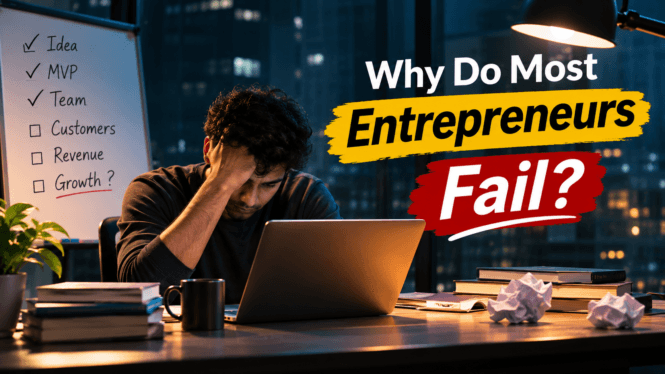
When I tell someone that I’m an entrepreneur, the first thing they usually imagine is freedom, money, a successful company, a big office, and a comfortable lifestyle.
But honestly, entrepreneurship doesn’t look like that most of the time.
There are days when you question your decisions, days when you don’t know how to manage the next month’s expenses, days when employees expect answers from you, and days when customers expect things you haven’t figured out yet.
And the interesting part? You still have to wake up the next morning and keep going.
We hear a lot of stories about successful founders. We read about companies raising millions, entrepreneurs building billion-dollar businesses, and startups becoming global brands.
But how often do we talk about the thousands of businesses that shut down every year?
How many founders invested their savings, borrowed money, hired people, built products, and eventually had to close everything?
I have always felt that we discuss success too much and failure too little.
So, why do most entrepreneurs fail?
I don’t think there is one particular reason. In most cases, it is a combination of small mistakes that eventually become big problems.
Let me share a few things I believe every aspiring entrepreneur should understand before starting a business.
Having an idea is easy. Finding someone willing to pay for it is difficult.
Almost everyone has a business idea.
Talk to a group of friends, and someone will tell you about an app they want to build, a platform they want to launch, or a business they believe can become the next big thing.
I have met many people who are genuinely passionate about their ideas. They spend weeks discussing features, choosing company names, designing logos, and planning how big the company will become.
But there is one question many of them forget to ask.
Who is going to pay for this?
I believe this is where the journey of many startups starts going in the wrong direction.
Founders become emotionally attached to their ideas. They believe their product is amazing, but the market may not even need it.
You don’t need 100 people telling you that your idea is good. You need a few customers who are willing to pay for it.
Before building anything, speak to people who might actually use your product. Understand their problems. Find out how they are solving those problems today and whether they are willing to spend money on a better solution.
A business is not built around what you want to create. It is built around what people need.
Revenue is exciting, but cash flow is what keeps you alive.
This is something I wish more first-time founders understood.
When a company starts generating revenue, everyone gets excited. You feel that things are finally moving in the right direction.
But revenue doesn’t necessarily mean your business is healthy.
Imagine your company generates ₹5 lakh in a month. Sounds great, right?
Now consider salaries, office expenses, software subscriptions, marketing, taxes, infrastructure, vendor payments, and other operational costs.
Suddenly, that ₹5 lakh doesn’t look as impressive.
Many entrepreneurs focus on increasing revenue without understanding where their money is going.
I have always believed that a founder should know the financial position of their company, even if they have an accountant or finance team.
Know your monthly expenses. Understand your burn rate. Keep track of receivables. Don’t spend money just because it is available in your bank account.
And most importantly, don’t build a business that depends on constantly borrowing money to survive.
You don’t always need to grow fast. Sometimes, surviving long enough to figure things out is itself a major achievement.
Your product doesn’t sell itself.
This is probably one of the biggest lessons in business.
A founder can spend six months developing a product, make it look beautiful, add dozens of features, and launch it with great excitement.
Then comes the reality.
Nobody is buying.
Why?
Because building a product and selling a product are two completely different skills.
I’ve seen entrepreneurs spend so much time discussing technology, features, and development that they forget about the customer.
Who will sell it? Where will the customers come from? How much will it cost to acquire one customer? Why should someone choose your product over an existing alternative?
These questions should be discussed before launch, not after it.
Your first customer is often more valuable than your first 1,000 website visitors.
Talk to customers. Make sales calls. Send emails. Attend meetings. Ask for feedback.
Sometimes, the founder himself needs to become the salesperson.
There is nothing wrong with that.
In fact, during the early stages, nobody understands your product better than you do.
Don’t confuse being busy with building a business.
Entrepreneurs are usually busy people.
There are meetings, calls, hiring discussions, product updates, networking events, emails, and a hundred other things happening every day.
But at the end of the month, ask yourself one question:
What have I actually achieved?
Did we acquire more customers? Did revenue increase? Did we improve the product? Did we solve an important problem? Did we build something that makes the business stronger?
Or did we simply remain busy?
I think this is a trap many founders fall into.
We sometimes spend more time discussing business than actually doing business.
Having a fancy office, attending startup events, posting regularly on LinkedIn, and calling yourself a CEO doesn’t automatically make you a successful entrepreneur.
What matters is execution.
Nobody pays you for how many hours you spend thinking about your business. Customers pay you for the value you deliver.
Hiring people is easy. Building the right team is difficult.
When you start a company, you naturally want people who believe in your vision.
You want a team that works together, takes responsibility, and helps the company grow.
But building that team is not always easy.
You will make hiring mistakes. Some people may leave when you need them the most. Some may perform differently from what you expected. Sometimes, you may realise that you hired someone for the wrong reasons.
And there is another side to this.
As a founder, you cannot expect every employee to think exactly like you. They have their own responsibilities, career goals, and personal lives.
Your job is to create an environment where people understand what they are working towards and have the opportunity to grow.
Don’t hire just to increase your headcount.
Hire because there is a real need.
A small team that executes well is often more valuable than a large team without direction.
Stop chasing every new opportunity.
This is something I personally find very interesting about entrepreneurs.
We are always looking for opportunities.
One day, we want to build a SaaS product. The next day, we discover an interesting AI business. A week later, someone introduces us to a completely different industry, and suddenly we start thinking about entering that market too.
There is nothing wrong with exploring opportunities.
But there is a difference between identifying an opportunity and having the capacity to execute it.
Every new business requires time, money, people, and attention.
If you keep dividing your resources between multiple ideas, you may end up building several incomplete businesses instead of one successful company.
I would rather spend three years building one meaningful business than spend three years starting ten different businesses without taking any of them seriously.
Focus is underrated.
Raising funding doesn’t mean you’ve succeeded.
Today, startup funding has almost become a celebration of its own.
A company announces a funding round, the founder gets featured in the media, and everyone congratulates the team.
But what happens after the funding announcement?
You still have to build the product, acquire customers, generate revenue, manage expenses, and eventually create a sustainable business.
Investment gives you resources. It doesn’t guarantee success.
Some founders spend months trying to convince investors instead of convincing customers.
Of course, external funding is important for businesses that need capital to grow. But don’t make fundraising your only definition of progress.
A company with paying customers, healthy margins, and a clear business model has something valuable.
Build a business that deserves investment rather than building a business only to raise investment.
The hardest part is not starting. It is continuing when things don’t work.
Nobody prepares you for the emotional side of running a company.
You can read books, attend startup events, listen to successful founders, and watch hundreds of interviews.
But when you are personally responsible for a business, things feel different.
There will be months when sales don’t happen as expected. There will be customers who don’t pay on time. There will be unexpected expenses. Sometimes, you will have to make decisions without knowing whether they are right.
And you cannot always share everything with everyone.
People see the founder, but they don’t always see the pressure behind that position.
There is a lot of responsibility involved in running a company.
You have to manage your customers, your employees, your finances, your partners, and your own expectations.
Some days will be good. Others will be extremely difficult.
But I have realised that being an entrepreneur is not about having all the answers. It is about being willing to find them, even when things are uncertain.
Sometimes, the founder is the biggest problem.
This might sound uncomfortable, but I believe it is important.
We often blame the market, competition, employees, investors, or the economy when a business doesn’t perform well.
Sometimes those factors genuinely contribute to failure.
But sometimes, the founder needs to look in the mirror.
Are you listening to customers?
Are you making decisions based on facts or emotions?
Are you managing money properly?
Are you giving your team enough clarity?
Are you willing to accept that your original idea might be wrong?
The biggest strength of an entrepreneur is not knowing everything.
It is having the ability to accept when something isn’t working and being mature enough to change it.
Your ego should never become more important than your business.
So, what should someone understand before becoming an entrepreneur?
I don’t want to make entrepreneurship sound frightening. Despite all the challenges, I genuinely believe building something of your own can be one of the most rewarding experiences.
But go into it with realistic expectations.
Don’t start a business just because you hate your job.
Don’t start a business because everyone around you is becoming an entrepreneur.
Don’t assume that having an innovative idea will automatically make you successful.
And don’t measure your progress against someone else’s LinkedIn post.
Start small if you have to. Find a real problem. Get your first customer. Learn how to sell. Understand your finances. Build a team slowly. Make mistakes, but make sure you learn from them.
You don’t need to look like a successful entrepreneur in the first year.
You need to become someone who understands how to build a business.
If there is one thing I would tell someone who wants to become an entrepreneur, it is this:
Don’t fall in love with the title of being a founder. Fall in love with the process of building something.
There will be no applause for the difficult decisions you make behind closed doors. Nobody will congratulate you for managing an unexpected expense or solving a problem that almost nobody knows about.
But those small decisions are what keep a business moving.
And if your first business fails, it doesn’t mean you should never try again. It means you have experienced something that cannot be learned entirely from a classroom or a business book.
Entrepreneurship is not a straight road. Sometimes you move forward, sometimes you take a step backwards, and sometimes you have to change direction completely.
That’s okay.
Just make sure that when you look back, you have learned something from every experience.
Because building a company is not about proving to the world that you are successful. It is about proving to yourself that you can create something valuable, even when the odds are against you.


