You have an idea. You believe it can become a business.
The next question is not, “How quickly can we build it?”
The better question is:
“What should we build first, and what do we need to learn before we build more?”
This is where product development becomes critical.
Many startup founders make the same mistake. They start with a long list of features, hire developers, invest heavily in design and technology, and spend months building a product before discovering that customers want something different.
A startup product roadmap should work differently.
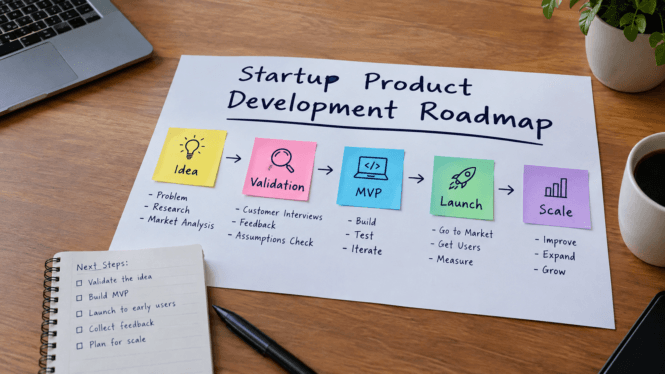
It should help you move from idea to validation, validation to MVP, MVP to real users, and real users to a scalable product.
And importantly, the roadmap should not be treated as a fixed plan. Early-stage startups learn as they build. The roadmap should change when the evidence changes.
The Startup Product Development Roadmap
A practical product development journey can be divided into these stages:
Problem → Research → Validation → Product Strategy → Prototype → MVP → Testing → Launch → Feedback → Product-Market Fit → Scale
Think of it as a loop rather than a straight line.
You may launch an MVP and discover that your original assumption was wrong. You may return to validation. You may change the target customer. You may remove half of your features.
That is not necessarily failure.
That is product development.
Recent startup-product frameworks increasingly emphasize short validation cycles and learning before committing to large feature roadmaps.
1. Start With the Problem
Before thinking about technology, define the problem.
A startup should not begin with:
“I want to build an AI app.”
or:
“I want to build a marketplace.”
Instead, start with:
Who has a problem, what exactly is the problem, and why is it important enough to solve?
Try to answer five questions:
- Who experiences the problem?
- How frequently does it happen?
- How are they solving it today?
- What does the existing solution cost them?
- Why would they switch to a new solution?
A simple problem statement can help:
“[Target customer] struggles with [specific problem] because [reason].”
If you cannot clearly explain the problem, it is probably too early to start development.
2. Understand Your Target Customer
A product is not built for everyone.
Your first product should have a clearly defined customer.
For example:
Instead of:
“Our product is for businesses.”
Try:
“Our product is for small e-commerce businesses that receive a high volume of cash-on-delivery orders.”
The second statement gives you something you can actually research.
Understand:
- Customer profile
- Industry
- Company size
- Buying process
- Existing tools
- Pain points
- Budget
- Decision-maker
- Current alternatives
Your first customer segment does not have to remain your only segment forever.
But you need somewhere specific to start.
3. Validate the Problem Before Building
This is one of the most important stages of startup product development.
Do not confuse interest with validation.
Your friends may say your idea is great.
Potential investors may say it sounds interesting.
A LinkedIn post may receive hundreds of likes.
None of these necessarily prove that customers need the product.
Talk to potential users.
Ask them about their current behavior rather than simply asking:
“Would you use my product?”
A better question is:
“How are you solving this problem today?”
Look for evidence of existing pain.
If customers are already spending money, time, employees or effort to solve the problem, that can provide stronger evidence that the problem is real.
4. Study the Existing Market
You don’t necessarily need to invent something completely new.
Many successful products improve an existing workflow.
Research:
- Direct competitors
- Indirect competitors
- Existing software
- Manual processes
- Spreadsheets
- Agencies and service providers
- Internal tools
- Alternative solutions
Then ask:
What can we do differently?
Your differentiation could be:
- Lower cost
- Faster workflow
- Better user experience
- Better automation
- Better data
- Better distribution
- Better customer support
- A specialized solution for a specific industry
The goal is not simply to create another product.
The goal is to understand why someone would choose yours.
5. Define the Core Value Proposition
Before development starts, you should be able to explain your product in one or two sentences.
For example:
“We help small businesses identify high-risk COD orders before dispatch.”
That’s much clearer than:
“We are building an AI-powered commerce intelligence platform.”
Your value proposition should explain:
Who + Problem + Solution + Outcome
For example:
We help [customer] solve [problem] using [solution] so they can achieve [outcome].
This statement becomes the foundation for your product, marketing and sales strategy.
6. Decide What the MVP Should Be
Now comes one of the most important decisions:
What should you actually build?
Your MVP is not your complete product.
It is the smallest useful version that allows you to test your core product hypothesis with real users.
For example, imagine you want to build a large SaaS platform with:
- AI agents
- CRM
- Analytics
- Automations
- Campaign management
- Calling
- Integrations
- Reporting
- Team management
You probably don’t need all of these in version one.
Your MVP might only need:
Login → Search → View result → Take one core action
Everything else can come later.
A useful question for every proposed feature is:
“Does this feature help us deliver the core value or learn something important?”
If not, it may belong in a later version.
Current MVP roadmap approaches commonly recommend prioritizing the smallest experiment that can validate the core hypothesis rather than planning a large feature-heavy roadmap.
7. Create the Product Prototype
Before investing heavily in development, turn the idea into something people can see and interact with.
This could be:
- Wireframes
- User flows
- Clickable Figma prototype
- Landing page
- Interactive demo
- Concierge MVP
- No-code prototype
The objective is to answer:
“Does this solution make sense to the user?”
You can discover major problems before writing thousands of lines of code.
A prototype can also help founders communicate the product to:
- Developers
- Designers
- Co-founders
- Investors
- Early customers
- Advisors
8. Design the User Experience
Once the core workflow is clear, design the product around the user.
Focus on the critical journey.
For example:
Sign up → Onboarding → Search → Result → Action → Confirmation
Do not try to perfect every screen.
Focus on the screens that determine whether users understand and receive value from the product.
A beautiful product with a confusing workflow will still struggle.
The goal of early design is not simply to make the product look good.
It should make the product easy to understand and use.
9. Plan the Technology Architecture
Now you can start making serious technology decisions.
Consider:
- Web or mobile
- Frontend
- Backend
- Database
- Cloud infrastructure
- APIs
- Authentication
- Payments
- Analytics
- Notifications
- AI/ML requirements
- Security
- Third-party integrations
- Data requirements
One common mistake is overengineering too early.
You don’t necessarily need a highly distributed architecture for a product with ten users.
At the same time, you should avoid architectural decisions that create unnecessary problems if the product succeeds.
The goal is:
Simple enough to move quickly. Structured enough to evolve.
10. Build the MVP
Now development begins.
Instead of trying to build everything simultaneously, divide development into focused iterations.
For example:
Sprint 1
Authentication and basic infrastructure
Sprint 2
Core product workflow
Sprint 3
Database and business logic
Sprint 4
Payments or core integrations
Sprint 5
Analytics and monitoring
Sprint 6
Testing and stabilization
The exact timeline depends heavily on product complexity, team size and integrations. Some current MVP frameworks use roughly 6–12 weeks as a planning window, but the important principle is scope discipline rather than an arbitrary deadline.
11. Test With Real Users
Do not wait until the product feels perfect.
Get it into the hands of a small group of real users.
You want to observe:
- Where users get confused
- Where they stop
- Which features they use
- Which features they ignore
- What they ask for
- Whether they return
- Whether they are willing to pay
This is where assumptions meet reality.
And reality is extremely valuable for a startup.
12. Launch a Controlled Beta
Your first launch doesn’t need to be a massive public launch.
A controlled beta can be much more useful.
Start with a limited number of customers.
For example:
10 → 25 → 50 → 100 users
depending on your product.
This gives your team enough feedback to identify problems before investing heavily in scale.
During this stage, monitor:
- Activation
- Engagement
- Retention
- Conversion
- Support requests
- Errors
- Feature usage
- Customer feedback
Do not focus only on signup numbers.
A thousand signups mean little if nobody uses the product.
13. Measure What Actually Matters
Every startup should define a small number of important product metrics.
For example:
Acquisition
How many relevant users are discovering the product?
Activation
How many users experience the core value?
Engagement
How frequently do users use the product?
Retention
Do users come back?
Conversion
Do users become paying customers?
Revenue
How much revenue is generated?
Churn
How many customers leave?
The exact metrics depend on your business model.
A B2B SaaS product and a consumer social application should not necessarily measure success in the same way.
14. Build the Feedback Loop
After launch, product development does not stop.
It becomes a continuous loop:
Build → Launch → Measure → Learn → Improve → Repeat
Collect feedback through:
- Customer interviews
- Support tickets
- Product analytics
- Surveys
- Sales calls
- User recordings
- Reviews
- Feature requests
- Churn interviews
But don’t blindly build every feature customers request.
One customer asking for a feature does not automatically mean it should become a product priority.
Look for patterns.
15. Prioritize the Next Features
Once you have real usage data, you can decide what to build next.
Separate features into categories:
Must Have
Required for the core product to work.
Important
Improves the primary user experience.
Growth
Helps acquisition, conversion or expansion.
Nice to Have
Useful, but not urgent.
Later
Potential future opportunities.
This prevents your roadmap from becoming a giant collection of feature requests.
A startup roadmap should be a decision-making tool, not a list of everything anyone has ever asked for.
16. Move From MVP to Product
Once the core product is being used consistently, you can start expanding.
You may add:
- Advanced features
- Integrations
- Automation
- Reporting
- Team functionality
- Mobile applications
- APIs
- AI capabilities
- Billing improvements
- Admin tools
- Advanced security
At this stage, the product roadmap should increasingly be informed by actual customer behavior.
The question changes from:
“Can we build this?”
to:
“Will building this create meaningful value?”
17. Strengthen the Product Infrastructure
Growth changes your technical requirements.
The architecture that worked for your first 50 customers may need improvement when you have thousands.
You may need:
- Better database architecture
- Caching
- Queues
- Monitoring
- Automated deployments
- Backup systems
- Security controls
- Load testing
- Performance optimization
- Infrastructure automation
- Disaster recovery
- Better observability
But this investment should be connected to actual product and business requirements.
Do not spend your entire runway preparing for millions of users when you have not yet demonstrated demand.
18. Prepare for Scale
Scaling is not only about servers.
You may need to scale:
Product
More features and better experiences.
Technology
More reliable infrastructure.
Team
Product, engineering, sales, marketing and support.
Operations
Processes, documentation and customer support.
Distribution
Repeatable acquisition channels.
Revenue
Pricing, packaging and expansion.
A scalable startup is not simply a product that can handle more traffic.
It is a business that can grow without costs, complexity and operational problems increasing at the same rate.
A Simple Startup Product Roadmap
Here is the entire journey in one view:
| Stage | Main Question | Output |
|---|---|---|
| Problem | What problem are we solving? | Problem statement |
| Customer | Who has the problem? | Target customer |
| Research | How is it solved today? | Market research |
| Validation | Is the problem real? | Validation evidence |
| Strategy | What should we build? | Product strategy |
| Prototype | Does the solution make sense? | Clickable prototype |
| MVP | What is the smallest useful product? | MVP |
| Testing | Does it work for real users? | Beta feedback |
| Launch | Will users adopt it? | Initial users |
| Measurement | What is actually happening? | Product metrics |
| Iteration | What should we improve? | New roadmap |
| Product | What should we expand? | Version 2+ |
| Scale | Can the business grow efficiently? | Scalable product |
The Biggest Mistake: Building Too Much Too Early
One of the biggest dangers for a startup is confusing development activity with progress.
Having 100 features doesn’t mean you have a successful product.
Having a sophisticated architecture doesn’t mean customers want the product.
Having a beautiful interface doesn’t mean users will return.
And having a long product roadmap doesn’t mean you have a strategy.
The real progress is learning:
Who needs the product.
Why they need it.
What they are willing to use.
What they are willing to pay for.
What makes them come back.
Your Roadmap Should Change
This is perhaps the most important principle.
Your initial roadmap is based on assumptions.
After talking to customers, those assumptions change.
After launching an MVP, they change again.
After collecting data, they may change again.
That’s normal.
A startup should be willing to say:
“We planned to build X, but the evidence tells us that Y is more valuable.”
That is not poor planning.
That is good product management.
Current startup product-development frameworks increasingly describe product development as an iterative process rather than a one-way sequence from idea to launch.
The Founder’s Product Development Checklist
Before moving from one stage to another, ask:
Before Building
- Is the problem real?
- Who has the problem?
- How are they solving it today?
- Have we spoken to potential customers?
- What is our core hypothesis?
Before MVP
- What is the single core workflow?
- What can we remove?
- What does the MVP need to prove?
- What metrics will we track?
Before Launch
- Can users complete the core workflow?
- Is the product stable?
- Can we track user behavior?
- Do we have a feedback process?
- Can we support early customers?
After Launch
- Are users activating?
- Are they returning?
- Which features create value?
- What causes users to leave?
- Are customers willing to pay?
- What should we build next?
Before Scaling
- Is there evidence of repeatable demand?
- Is the product reliable?
- Is the infrastructure ready?
- Are acquisition and retention improving?
- Does the business model support additional investment?
Building a startup product is not about getting from idea to finished product as quickly as possible.
It is about getting from idea to evidence as efficiently as possible.
The best roadmap is rarely the one with the most features.
It is the one that helps you answer the most important questions with the least unnecessary investment.
Start with the problem.
Understand the customer.
Validate the demand.
Build the smallest useful product.
Launch it.
Listen to users.
Measure what happens.
Improve the product.
Then scale what works.
Build less. Learn faster. Improve continuously.
That is the product development mindset every startup founder should have.


