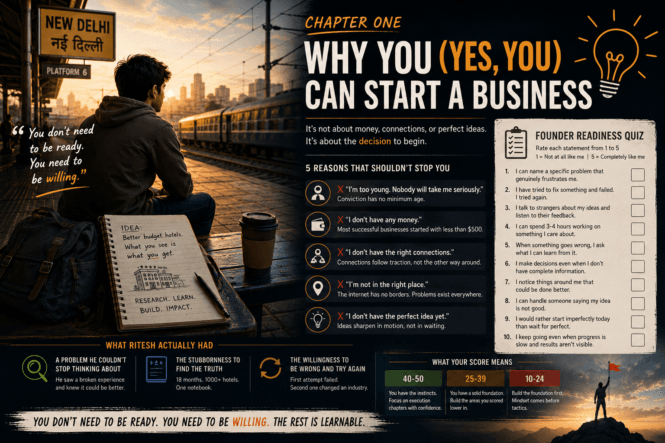
The boy on the platform had $150 in his pocket.
That was everything, the total sum of his plan. He had a one-way train ticket to Delhi, a notebook with a broken spine, and an idea so half-formed it barely deserved the word. He had never run a business. He had never raised investment. He had no connections in the city he was heading to, and no guarantee that anyone there would care what he thought about anything.
He was eighteen years old, from a small town in one of the poorest districts in India, and he was about to do one of the most useful things a young entrepreneur can do: go find out the truth for himself.
We will come back to him. But first, let us talk about you.
* * *
The five things that are probably stopping you
Before you start a business, you will hear a lot of reasons why now is not the right time. Some of those reasons will come from other people. Most of them will come from inside your own head. They sound responsible. They sound realistic. And almost all of them are wrong.
Here are the five most common ones and the truth behind each.
✕ “I am too young. Nobody will take me seriously.”
Ritesh Agarwal founded OYO Rooms at eighteen. Tilak Mehta founded a logistics company in Mumbai at thirteen. Julian Rios Cantu co-founded a medical technology company at sixteen after watching his mother survive cancer twice. Age is a headline. What people actually respond to is conviction, and conviction has no minimum age.
✕ “I don’t have any money.”
Most successful businesses started with under $500. Aadit Palicha and Kaivalya Vohra — founders of Zepto, now valued at $5 billion- started their company as a WhatsApp group. No office, no technology, no investment. Just two people, two phones, and a problem worth solving. Financial constraints do not stop businesses. They shape them. Often for the better.
✕ “I don’t have the right connections.”
Connections follow traction. You do not need to know the right people before you start; you need to do something worth knowing about. When Ritesh Agarwal first arrived in Delhi, he knew nobody. Within a year, investors were coming to him. Connections are a result of starting, not a precondition for it.
✕ “I am not in the right place. My city, my country, my ecosystem is not set up for this.”
Brian Gitta built a prize-winning medical device from Kampala, Uganda. Leandro Leviste founded Southeast Asia’s largest solar energy company from Manila. The internet has no borders. Markets exist everywhere. Problems exist everywhere. You are not disqualified by your address.
✕ “I don’t have the perfect idea yet.”
The perfect idea is a trap. It gives you something to wait for, and waiting feels productive without being productive. Every founder in this book started with an imperfect, half-formed observation. The idea sharpened in motion. It did not arrive fully formed while they were sitting still.
None of these things- age, money, connections, location, or the absence of a perfect idea stopped any of the founders you will meet in this book. They will not stop you either, unless you decide to let them.
* * *
The boy with the notebook
His name was Ritesh Agarwal, and he grew up in Bissam Cuttack and a small town in Rayagada, Odisha, one of the most economically underdeveloped districts in India. As a teenager, he sold SIM cards and consumer products to earn money, learning the mechanics of buying and selling long before anyone had given him a formal lesson in business.
By eighteen, he had a feeling the kind that is hard to explain but impossible to ignore. India had millions of small, unbranded budget hotels. They were everywhere. And almost all of them were terrible. Not because the owners were bad people, but because nobody had ever helped them be better. Travellers took a chance every time they checked in. The photos online looked nothing like the rooms. The quality was wildly unpredictable. The experience was broken.
Ritesh dropped out of college and bought a one-way train ticket to Delhi with that $150. He did not go there to raise money or pitch investors. He went there to find out if his feeling was right.
For the next eighteen months, he became a kind of undercover researcher. He slept in over a thousand cheap hotels across India. He ate street food. He kept that battered notebook, rating every room by mattress quality, Wi-Fi speed, cleanliness, and the attitude of the staff. Sometimes the rooms cost $3 a night. Sometimes less. He wrote detailed reviews under different names on travel websites, building up a picture of what budget travellers actually experienced versus what they hoped for.
What he discovered was this: the problem was not that the hotels were bad. The problem was that there was no standard. A traveller could have a perfect night in one place and a miserable one three streets away, and there was no way to know in advance which was which. The owners knew their properties were inconsistent. They were desperate for help but had no idea where to begin.
His first attempt at a solution was called Oravel Stays, a platform for listing and booking budget rooms, modelled loosely on Airbnb. It flopped. Too complicated. Too unfocused. He had built something nobody particularly needed.
So he did not give up. He changed the question.
Instead of asking how to list rooms, he asked how to standardise them. He began approaching hotels directly, auditing their properties, telling owners exactly what changes to make, and bringing them under a single brand with a simple promise attached to it: what you see is what you get.
He called it OYO Rooms. He launched in 2013 with five hotels in Gurgaon. By twenty-two he was a millionaire. By twenty-nine, OYO was valued at $10 billion, operating in eighty countries, and booking more hotel nights annually than Hilton.
He did all of this without a degree, without family wealth, without connections, from a town most people have never heard of, with a notebook and a question he could not stop asking.
He did not wait until he was ready. He went and found out what ready actually required.
* * *
What Ritesh actually had
When people hear this story, they tend to focus on the outcome: the billion-dollar company, the global expansion, the youngest self-made billionaire in India. That part is impressive. But it is not the useful part.
The useful part is what Ritesh had at the very beginning, when he was still just a teenager on a train with $150 and a broken notebook.
He had a problem he could not stop thinking about. He had the stubbornness to go find the truth firsthand, even when that meant eighteen months of cheap hotels and street food. And he had the willingness to be wrong to build something, watch it fail, and try again with what he had learned rather than walking away.
None of that costs money. None of it requires the right city, the right university, or the right family background. It requires a decision, the decision to take the thing that is bothering you seriously enough to actually do something about it.
That decision is available to you right now. Not when you are older, not when you have more money, not when the timing is better. Right now. Wherever you are reading this.
The rest of this book is about what comes after that decision. How to find the right problem. How to test your idea cheaply. How to get your first customers. How to build something real. But the decision to begin? That is yours alone.
* * *
A question before we go further
You might be reading this and thinking: that is a great story, but Ritesh is different from me. Maybe you feel you are not bold enough, or organised enough, or experienced enough. Maybe the gap between where you are and where you want to be seems too wide to cross.
That feeling is completely normal. Nearly every founder you will meet in this book felt exactly the same way when they started. The question is not whether you feel uncertain; it is what you choose to do with the uncertainty.
The quiz below is not a test. There is no pass or fail, and no one is grading you. It is a mirror: a way of seeing your starting point clearly, so you know both what you are building on and what you still need to develop. Answer it honestly, and it will tell you something genuinely useful about where to focus your energy as you read on.
Framework: The founder readiness quiz
For each statement below, give yourself a score from 1 to 5.
1 = Not at all like me. 5 = Completely like me.
1. I can name a specific problem in my daily life, community, or industry, I know that genuinely frustrates me.
2. I have tried to fix or improve something before and failed. I tried again.
3. I am willing to talk to strangers about my ideas and actually listen to what they say, even when it is uncomfortable.
4. I can spend three or four hours working on something I care about without being paid for it.
5. When something goes wrong, I tend to ask what I can learn from it rather than simply moving on.
6. I am comfortable making a decision even when I do not have complete information.
7. I regularly notice things around me in shops, services, apps, systems that could be done better.
8. I can handle someone telling me my idea is not good without it ending my interest in the idea.
9. I would rather start something imperfect today than wait for the perfect version that may never arrive.
10. I can keep going when progress is slow and results are not yet visible.
What your score means
40 to 50 — You have the instincts. The mindset is there. Move through this book with confidence and focus your energy on the practical chapters: finding your idea, testing it cheaply, and getting your first customers.
25 to 39 — You have a solid foundation with some clear areas to develop. Look at which questions scored lowest — those are the places this book will help you most. Pay particular attention to Part One.
10 to 24 — You are earlier in the journey than some. That is completely fine. It means the first three chapters matter most for you right now. Do not rush ahead to the tactics before the mindset is in place. Build the foundation first.
One important thing: this quiz measures where you are today, not where you will be. Founders are not born with these qualities. They build them through doing, failing, reflecting, and trying again. Every question you scored low on is simply a skill waiting to be learned.
Your score is your starting line. It is not your ceiling.
* * *
You don’t need to be ready. You need to be willing. The rest is learnable.


